
 English
 русский
 Français
 Español
 Português
 Deutsch
 عربى
عربى

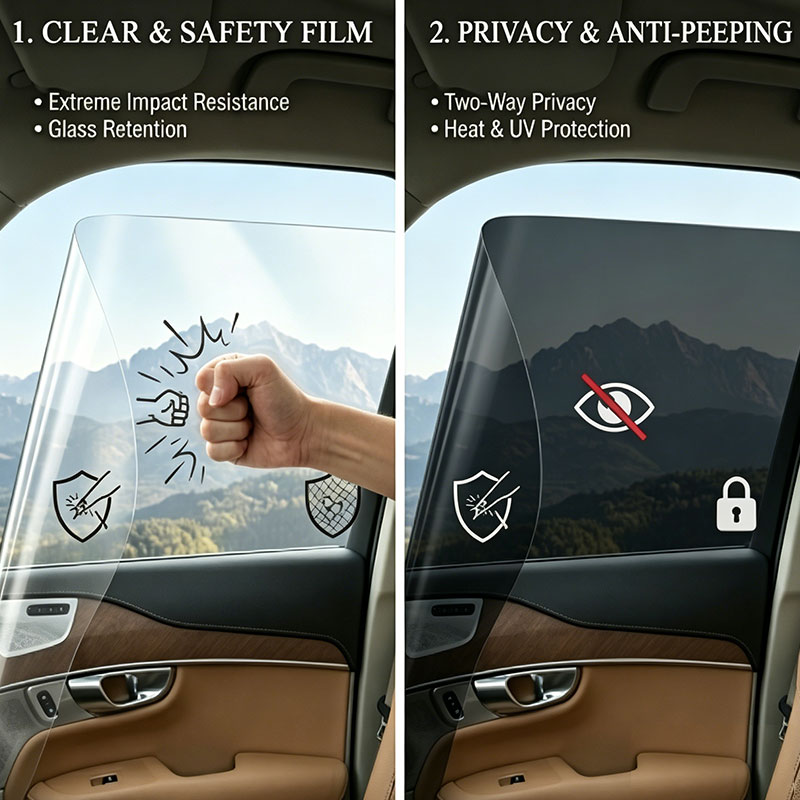
Película para vidros automotivos Clear & Safety
Uma película híbrida de alto desempenho projetada para oferecer segurança e transparência máximas. Possui uma camada de segurança de alta resistência para evitar que o vidro se estilace em caso de impacto, combinada com proteção essencial contra raios infravermelhos para um interior mais fresco e seguro.
A Película Transparente e de Segurança para Vidros Automotivos é uma película híbrida de alto desempenho projetada para oferecer segurança e clareza equilibradas para os vidros dos veículos. Ela integra uma camada de segurança extra-resistente que ajuda a manter os fragmentos de vidro quebrado juntos em caso de impacto, reduzindo o risco de estilhaços voando e aumentando a proteção dos passageiros. Esse reforço estrutural mantém a integridade geral do vidro em colisões leves ou choques externos.
Além da segurança, a película inclui propriedades confiáveis de rejeição de infravermelho para bloquear uma parte significativa do calor solar. Ao reduzir o acúmulo de calor no interior da cabine, ela ajuda a manter uma temperatura interna mais confortável, alivia a carga sobre o ar-condicionado do veículo e cria um ambiente de direção mais agradável.
Projetado para o uso prático diário, o filme preserva alta transparência à luz para uma visibilidade externa nítida, sem escurecimento ou distorção excessivos. Ele contribui para uma direção mais segura, mantendo boa visibilidade dia e noite, ao mesmo tempo em que oferece durabilidade e estabilidade a longo prazo. Essa combinação de desempenho em segurança, gerenciamento de calor e visão clara torna-o uma atualização funcional e focada no usuário para a proteção automotiva no dia a dia.
Informações a atualizar
Industry Knowledge
Tear Propagation Resistance: The Invisible Safety Net
The safety function of CLEAR & SAFETY AUTOMOTIVE WINDOW FILM relies not merely on tensile strength but on the material's ability to resist tear propagation once a crack initiates. When road debris strikes a side window, a standard PET-based film may arrest the initial impact yet allow a tear to zip across the pane along the crystallite boundaries. Anhui He He New Materials Co., Ltd., established in 2019, engineers the polymer morphology within its full-industry-chain extrusion platform to create a tortuous path for crack advancement. By optimizing the biaxial stretching ratio and thermal relaxation steps during the precision coating production of the TPU clear layer, we induce a micro-domain structure that diverts fracture energy laterally. This transforms what would be a catastrophic window blowout into a localized star crack. As a direct manufacturer, HEHE measures Elmendorf tear values not just in the machine direction but comprehensively across all axes, ensuring the CLEAR & SAFETY AUTOMOTIVE WINDOW FILM maintains passenger compartment integrity during side-impact collisions, a critical consideration that surpasses the minimum anchor standards often met by commodity wholesale clear protective film.
Spall Shield Mechanics and Glass Fragment Adhesion
A windshield safety film's primary duty is to laminate shattered glass, preventing facial lacerations from spall—the high-velocity glass shards propelled inward during impact. This performance parameter, called "spall shield efficiency," is dictated not by film thickness alone but by the viscoelastic coupling between the adhesive and the glass fracture surface. Anhui He He New Materials Co., Ltd. formulates its specialty adhesive with a high intrinsic damping coefficient. During the rapid, high-frequency oscillations of an impact event, this adhesive remains glassy and energy-absorbent, capturing fragments instantly. Concurrently, the functional coating formulation on the air-side includes a low-surface-energy slip layer that resists scratching during daily use without compromising the underlying TPU's elongation. Within our in-house R&D platform, we test spall capture at -20°C, as cold substrates make standard adhesives brittle and ineffective. Our in-depth customization allows us to tailor the adhesive's dynamic mechanical analysis curve for an optimal glass transition point, providing consistent life-protective performance across all climate zones without the yellowing risk associated with traditional PVB interlayers.
Optical Refraction Matching for ADAS Recalibration Avoidance
Applying a CLEAR & SAFETY AUTOMOTIVE WINDOW FILM to a windshield housing forward-facing Advanced Driver-Assistance Systems cameras introduces a refractive interface. If the film's surface flatness deviates from the windshield's lamination specification, light rays bend before reaching the camera lens, potentially triggering a recalibration fault. Anhui He He New Materials Co., Ltd. leverages its background serving the 3C electronics industry to produce films with optical-grade retardation uniformity. Our precision coating production platform controls coating die lip precision to sub-micron levels, eliminating the wedge-shaped thickness variations that cause prismatic image shift. The table below illustrates how fundamental film properties translate into ADAS-compatible installation outcomes, an engineering consideration that transforms a simple clear film into a critical optical component:
| Optical Parameter | Uncontrolled Wholesale Film Risk | HEHE Controlled Specification Outcome |
| In-Plane Retardation (nm) | > 100nm causes birefringence artifacts | < 20nm (Retains camera image sharpness) |
| Transmitted Wavefront Distortion | Visible mottling in structured light grids | Uniform interference fringe pattern (Flat) |
| LIDAR Compatibility (905/1550nm) | Unknown transmission drop-off | Documented >90% near-infrared transmittance |
The Anti-Bloom Formulation: Preventing Plasticizer Fogging
A stealthy degradation mechanism in CLEAR & SAFETY AUTOMOTIVE WINDOW FILM is internal plasticizer migration, which manifests as a sticky, foggy film on the cabin-side surface months after installation. Standard TPU formulations often include migratory plasticizers to achieve flexibility. Under solar heating, these low-molecular-weight additives volatilize and condense on the cooler inner film surface, creating a hazardous glare-inducing haze. Anhui He He New Materials Co., Ltd. formulates inherently flexible polymer backbones within its full-industry-chain production system, completely bypassing external plasticizers. Our functional coating formulation incorporates a crosslinked anti-bloom barrier that hermetically seals the film composite. As a direct manufacturer of wholesale TPU clear protective film for cars, we guarantee that the 1000-hour fogging test per DIN 75201 yields a reflectance deviation of less than 2%. This prevents the gradual "ghost" buildup on the windshield interior, ensuring the optically neutral transparency remains stable for years in the presence of aggressive cockpit outgassing from new energy battery cooling systems or high-temperature cabin soak conditions in parked vehicles.
Edge Seal Chemistry Against Electrolytic Corrosion
Where CLEAR & SAFETY AUTOMOTIVE WINDOW FILM edges meet aluminum window moldings or carbon-fiber roof frames, galvanic coupling can occur if conductive moisture bridges the gap. This results in a dendritic, fern-like tarnish pattern creeping under the film, destroying the invisible look. Anhui He He New Materials Co., Ltd. engineers the edge interface by incorporating hydrophobic silane terminations within the specialty adhesive layer. During the precision coating production, the edge bead of the adhesive roll is formulated with a slightly higher crosslink density and a lower water vapor permeation coefficient. This creates an "edge-seal effect" without requiring a separate liquid sealant bead during installation. For our contract manufacturing partners serving the automotive beauty market, we can tailor this edge chemistry to be compatible with specific ceramic detailing coatings often applied post-installation, ensuring that the clear film's integration with luxury trim remains pristine. This electrochemical isolation is a direct extension of our corporate mission to provide cutting-edge film solutions that address not just impact safety but also long-term material compatibility within the complex vehicle assembly environment.
Acoustic Performance and Sound Transmission Loss as a Safety Factor
Driver fatigue contributes to accidents, and the acoustic dampening property of a safety film directly influences cabin noise levels. High-frequency wind noise penetrating side glass can be attenuated by the viscoelastic nature of the TPU layer in a CLEAR & SAFETY AUTOMOTIVE WINDOW FILM. Anhui He He New Materials Co., Ltd. measures the loss factor at frequencies between 1000 and 4000 Hz, the primary range of human speech and wind rush. By adjusting the damping coefficient of the TPU substrate without changing the visible transparency, our in-depth customization platform enables automotive beauty brands to offer a "silent safety" upgrade. The list below highlights the acoustic benchmarks we achieve through our integrated R&D and manufacturing control, distinguishing our product from acoustically inert standard films:
- Center-of-mass sound transmission loss improvement of 3–5 dB at 2000 Hz compared to uncoated tempered glass, achieved through constrained-layer damping between the TPU and the glass substrate via the viscoelastic adhesive.
- Coincidence dip dampening: The inherent material hysteresis of our TPU formulation reduces the sharp sound transmission loss drop typically seen around 3150 Hz, flattening the noise curve entering the passenger compartment.
- Low-frequency boom mitigation: While window films primarily affect high frequencies, the micro-layering in our functional coating formulation adds mass-per-unit-area resistance that fractionally dampens the transmission of low-frequency road rumble transmitted through the body structure into the glass.
The Thickness Paradox: Structural Hardening vs. Optical Purity
Increasing the thickness of a CLEAR & SAFETY AUTOMOTIVE WINDOW FILM to 8 mil or 10 mil directly boosts penetration resistance, yet introduces a significant aesthetic risk: a yellow edge hue visible around the perimeter of side windows. This yellowing is not degradation but rather the intrinsic optical absorption of the thicker polymer mass-path. Anhui He He New Materials Co., Ltd., established in 2019, combats this through monomer purification during raw material synthesis rather than relying on optical brighteners that rapidly deplete under UV exposure. Our full-industry-chain production allows us to specify ultra-low metal-catalyst residues in the aliphatic TPU base, which are the primary yellowing initiators. As a direct manufacturer providing wholesale clear protective film, we publish the initial b* value in the CIELAB color space for any given film thickness. For brands wanting to build differentiated brand competitiveness, we can tailor the film thickness up to 12 mil for military-grade security applications while maintaining a b* below 1.0, ensuring the window frame surround does not reveal a sickly amber tint when viewed edge-on under showroom lighting. This commitment to chromatic purity is fundamental to the "CLEAR" aspect of the product, proving that safety and perfect optical aesthetics are engineered simultaneously on our precision coating platform.
Integration with New Energy Battery Fire Retardancy Standards
Safety films in electric vehicles now confront a new demand beyond crash protection: flame retardancy to delay cabin ingress of battery thermal runaway ejecta. Standard TPU films melt and drip, potentially acting as a fuel source. Anhui He He New Materials Co., Ltd. leverages its expertise in the new energy battery industry to formulate halogen-free, intumescent fire barriers within the functional coating and adhesive stack. This CLEAR & SAFETY AUTOMOTIVE WINDOW FILM achieves a UL94 V-0 classification, forming a stable char layer when exposed to direct flame rather than propagating the flame front. The underlying chemistry involves phosphorous-based polyols integrated into the specialty adhesive R&D synthesis, not post-additive blending. During our precision coating production, we can create a stratified architecture: a fire-resistant adhesive against the glass and an abrasion-resistant clear coat on the cabin side, an engineering duality that showcases our ability to offer in-depth customization of film performance. This advancement positions HEHE as a supplier of film solutions where occupant protection encompasses both the kinetic energy of collision and the thermal energy of potential electrical failure, a holistic safety approach for the modern vehicle platform.
Precision Die-Cutting for Exterior Body Panel Safety Patches
Beyond glass, CLEAR & SAFETY AUTOMOTIVE WINDOW FILM technology migrates to exterior high-impact zones on supercars and armored vehicles, functioning as a sacrificial anti-spall laminate on carbon fiber fenders. These components shatter into sharp splinters under collision. Anhui He He New Materials Co., Ltd. supplies pre-cut body panel kits using the same TPU clear protective film base. The functional coating formulation is stiffened to resist high-speed gravel penetration, while the adhesive is designed to remain bonded under the tension of deforming composite material. Our full-industry-chain manufacturing platform allows intricate die-cutting with tolerances of ±0.2mm, providing a seamless factory-appearance edge that does not lift at 150 mph. As TPU Clear PPF Manufacturers, we merge the cosmetic protection DNA of paint protection film with the no-compromise laminate containment properties of safety film, offering wholesale solutions that serve both the automotive beauty sector and the specialized protective equipment market simultaneously under the unified quality system of our R&D and manufacturing platform.
Anisotropic Shrinkage Control During Professional Installation
The installation complexity of CLEAR & SAFETY AUTOMOTIVE WINDOW FILM on curved backlites stems from the anisotropic shrinkage properties of biaxially oriented films. If the film shrinks more in the machine direction than the transverse direction when heated, the installer must over-stretch the material, inducing internal stresses that later cause "peanut" shaped adhesive failure spots. Anhui He He New Materials Co., Ltd. balances the orientation release stress during the film forming phase of its precision coating production. We ensure symmetric shrinkage within 1% in both axes at 180°C, a critical thermal-mechanical parameter. The table below contrasts typical industrial film behavior with the controlled relaxation we achieve as a direct manufacturer, which directly impacts the installer's success rate and the long-term edge adhesion that maintains the film's life-saving integrity:
| Shrinkage Parameter | Unbalanced Generic Film | HEHE Symmetric Clear Film |
| MD/TD Shrinkage Ratio at 180°C | > 3:1 (Causes fingering on compound curves) | < 1.2:1 (Behaves predictably under heat gun) |
| Memory Effect After Thermoforming | High spring-back leads to edge lift | Stress-relaxed, conforms permanently |
| Bond Line Uniformity Post-Shrink | Variable tension across adhesive layer | Isotropic adhesive wet-out retained |
-
 No. 5, Datang Road, East District, Development Zone, Guangde City, Xuancheng City, Anhui Province,242200, China
-
 [email protected]
-
 +86 18170340295
Direitos autorais Anhui He He New Materials Co., Ltd. Todos os Direitos Reservados.
 Filme TPU PPF por grosso Fabricante de TPU PPF automóvel